One Of The Best

If you listen to the Today Programme on BBC Radio 4 on a regular basis, then the name of John Humphrys will be very familiar to you.

He was the scourge of the dodging politician and, on his day, an expert at the holding to account interview.

He recently signed off from the Today Programme - and we thought that that was worth marking

There are too many examples of his grilling interview technique to list here - but the one that many people point to, is when John Humphrys essentially ended the career of a BBC Director General - George Entwistle. If you've never heard it before, it's worth a few moments of your time...

From our point of view, it's an incredible interview.

Just think - how would you fare if you had to interview your boss?

That's what John Humphrys did - and he didn't hold back one little bit.

It's a lesson to all. To interviewers - how to hold people to account; to interviewees - how to openly admit the facts of a story. Don't dodge the uncomfortable answer just because you don't want to look bad. If you've dropped the ball - other people know it, so you've got to fess up!

Make A Statement!

For this media analysis, we don't want to look at an interview. In fact, we want to do the exact opposite and look at a statement.

Watch this statement, being read out by Thomas Cook's chief executive, Peter Fankhauser. Again, just to point out that we're not making a judgement on the story - Thomas Cook, Peter Frankhauser, the workers etc - we are impartially examining a statement given on a major news story.

It has been a real struggle of late for Thomas Cook and we can only imagine the anxiety and distress that the former workers of the company are going through.

However, we thought that it was important to look at Peter Fankhauser's statement, as it contains some important media training techniques.

First of all, the structure. He structured the statement well. He started with the news, went on to sympathise and thank those affected - workers, customers, suppliers - only mentioning himself briefly at the end.

That shows empathy towards those that are affected. The order of thanks was important too, in firming up that empathetic stance. The workers - they are the thousands of people who are starting the day without a job, the customers - they are the hundreds of thousands of people who are either stranded or now have to start rearranging their future travel plans, and the suppliers.

He didn't make the mistake that BP CEO Tony Hayward made back in 2010. Talking about the effect of the Gulf of Mexico oil spill, Mr Hayward said "There's no-one who wants this thing over more than I do. I want my life back". Bad move. Talking about how such a huge disaster is inconveniencing you is not the way to gain the sympathy, support or understanding of the press or the public.

It would have been like Peter Frankhauser beginning the statement by saying "I'm really tired, actually. I've not been sleeping that well recently - and I'm grateful that I can now stop worrying about it all". How horrendously insensitive would that be?

Let's not fool ourselves, though. Peter Frankhauser won't be financially affected himself - he's reputed to worth about $15bn - but if he came out with a nonchalant or unconcerned attitude, no-one would care about the statement and he would just be painted as another uncaring billionaire.

He paces the statement well too. He doesn't rush it, but delivers it in a meaningful, sombre way which reflects the tone of the news that he's having to share.

One final point to make too. As he finishes and begins to turn away to walk back into the office building, a reporter asks "Do you take personal responsibility?" - he did the right thing by not answering.

Let's look at why. Normally, we tell our clients that they should always answer the question that they've been asked - but this is one of the times when it's okay not to answer.

First of all, it's likely that the press would have been told beforehand that Peter Frankhauser wouldn't be taking questions and we're sure that he feels he's covered all of the important pertinent information that's needed right now.

There should definitely be a more 'emotional' interview with Peter Frankhauser at some point, where fingers can be pointed and blame can be laid - but this wasn't the time.

Also - if he had answered one question, that would have started an avalanche of questions and he would still be there now, answering them. In all honesty, he probably wouldn't have had the information to hand to answer the vast majority of them, and that would have left us all feeling a little dissatisfied.

Sport Interviews

I want you to watch the interview that BBC Sport did with Manchester City boss Pep Guardiola recently. It's the focus of this media training article...

Click here for Pep Guardiola Interview

Okay - let's leave to one side the discussion about non-English speaking managers and their command of the English language.

Pep Guardiola isn't too bad - but it's still not great

However, the thing we want to focus on here is something that you don't see in a lot of sporting interviews.

When a team has been beaten, they tend to find fault in the weather, the pitch, the match officials - everything but themselves.

Refreshingly, Pep Guardiola doesn't do that here. He talks about how well Norwich City played in the match and it's only when the journalist presses him on some of Manchester City's shortcomings in the match that he speaks negatively.

Now, when we say "negatively", he's still pretty reluctant to throw his players under the bus, as it were. He talks about how football is a game that changes pretty quickly, and that Norwich City are a formidable team. Then, right at the end of the clip, he makes a comment about how they could have played better in the final third of the pitch.

There is something in here that we can all learn from when we are giving interviews - you can still be truthful without giving in to negativity.

From a journalists point of view, the manager criticising the team is something worthy of a headline or two. The trick that Pep Guardiola, and a few other managers, use is to avoid that, whilst still talking truthfully.

So - when the interviewer points out that Manchester City's passing wasn't as good as it could have been, Pep Guardiola concedes the point without repeating it. In fact, he just nods his head and moves on to the comment about Manchester City lacking something in the final third of the pitch. 

He doesn't single out any particular player when he talks about this, he just makes the comment and moves on.

That's where the lesson is. 

If you're being asked about something where you're department/team/unit/company haven't performed as well as they could have - it's okay to concede the point (if you agree with it, of course!), but don't dwell on the negative. 

People watching that interview will have come away with a positive image of Manchester City, Pep Guardiola and, if they're new to the sport, football in general. All because he didn't 'go negative' and criticise everyone but himself.

The humility, the deference to Norwich City is an incredible strength here, and one that many interviewees could learn.

If you want to speak to us about how we could help you or your business with their media training, get in touch here

A Girly Swot

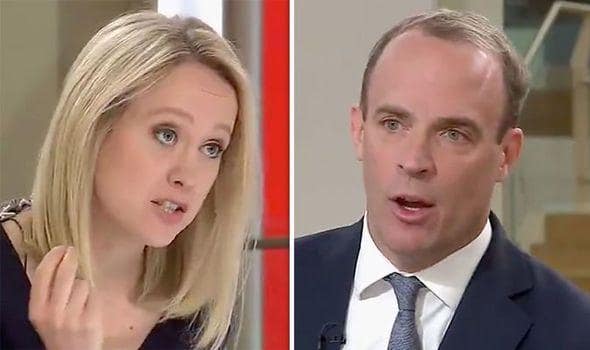
Dominic Raab MP appeared on Sophy Ridge recently, and was questioned about Boris Johnson calling David Cameron 'a girly swot' and Jeremy Corbyn 'a big girl's blouse'

Click the link to watch of the interview first...

Okay. You've seen it...

As always, I have to point out that I am not pushing any political viewpoint with this article. This is purely looking at how people behave during media interviews.

It's only a short excerpt from the interview - but there's an important point to be made with this section.

Clearly, when Sophy first brings up the Prime Ministers comments Dominic is uncomfortable - but he also is expecting it. Of course he is.

That should be a part of your Interview Prep - working on the questions you don't want to be asked.

In the final question, though, is where the interesting aspect of this interview occurs.

Sophy asks "So, a girly swot is a compliment then?"

And Dominic Raab MP replies "You can call me a girly swot any time"

Sophy laughs and ends the interview.

Dominic Raab MP's answer is a good one, but a little risky.

It's a classic Politician's Dodge - answering the question without actually answering the question - but he does it with a large side of flirting.

That's the risky part.

Get it wrong and you come across as creepy - but I think that Dominic Raab MP just about gets away with it.

The question was one that was meant to trap the unsuspecting interviewee.

If he had answered 'yes, it is a compliment' then Sophy could have questioned further about why the Prime Minister was complimenting David Cameron and Jeremy Corbyn.

If he had answered 'no, not at all' then Sophy would have had the story that the Prime Minister openly insulted David Cameron and Jeremy Corbyn.

Dominic Raab MP knew this - and came back with the answer that is in the interview.

This is one of those occasions where the truth isn't necessarily the best path, and I mean "truth" as in the answer that directly responded to the question. 

Now, whilst I don't know the Prime Minister's mind - I'm guessing that he did mean 'big girl's blouse' and 'girly swot' as insults. They aren't the worst things you could say about someone - but they are clearly phrases from yesteryear and don't really have any place in 2019 - and certainly not in politics.

Dominic Raab MP didn't want to get into that discussion on live TV - so went down the disarming and flirting route. 

If this was the first time that he had been interviewed by Sophy, or the first time that they had met face to face, I would have advised against it. However, there is some rapport between them - and Dominic Raab MP responds to that with this answer.

I'll confess to being quite impressed with Dominic Raab MP's answer. It was playful, human and raised a smile. 

The only thing that could have gone wrong is if Sophy has asked the question again, pressing him for a more direct answer to the question. All of the humour, the rapport, the flirting would have gone out of the window.

Watching it, though, I'm pretty sure that Dominic Raab MP knows that this is the end of the interview and knows that he is largely off the hook.

It worked this time - but next time could be so much more awkward.

If you want to talk more about how we could help you with media training, get in touch here

All Talk

Have a look at this interview that Michael Gove gave to Andrew Marr on the BBC recently...

Okay, before I start, I will just reiterate the same phrase that I always use - this piece has nothing to do with politics. I'm not here to condemn or condone anyone's political stance - nor am I saying that I agree or disagree with the BBC, Andrew Marr or any other news interviewer.

This is just about the Media Training side of things.

In particular, with this interview, I want to look at what happens from about 33 seconds in, right through until about 55 seconds in.

In that time frame - 22 seconds - Andrew Marr is trying to ask a question; and Michael Gove MP won't let him. Why is that?

Well, there are a couple of reasons. The most obvious one is that he's not done answering the previous question and wants to make sure that he gets his point (and Key Message) across to the viewers.

The less obvious reasons could be:

  • Power. By not allowing the interviewer to interrupt you , you are taking control of the interview. You become the person in power. My only criticism of that way of thinking, is that too many people see press interviews as some kind of exam. You're being tested on your knowledge and if you get it wrong, then you'll be cast out from society. That's just not true. If you get something wrong within your specific field of knowledge then, yes, expect some more difficult questions.
  • Thinking You Know What The Next Question Is. There was a part of me, whilst watching this clip, that felt that Michael Gove MP wouldn't let Andrew Marr ask the next question because he thought that he knew what the next question would be - and he didn't want to answer it!

This is a tricky situation to deal with, from a media training point of view. My advice is to always be polite; never just loudly talk over the interviewer until they give up and let you carry on with your answer. Also - always answer the question. This is where your Interview Prep would come in - have you practised answering the difficult, awkward questions?

Opinion is split with the behaviour that Michael Gove MP shows here. Some would say that he is being forceful and confident in the way he answers; other would say that he is being rude and disrespectful to Andrew Marr by not allowing him to speak.

The only thing I will say is this - would Michael Gove MP be the same way if he was speaking to a member of the public?

When you are being interviewed by anyone in the media, no matter how confrontational, no matter how much you are being pushed to snap or show anger - don't. As soon as you become hostile, belligerent or combative you risk losing the respect of the viewer.